


A Comprehensive Guide to Different Types of Colour Blindness
Published on November 14th, 2024
 Canada

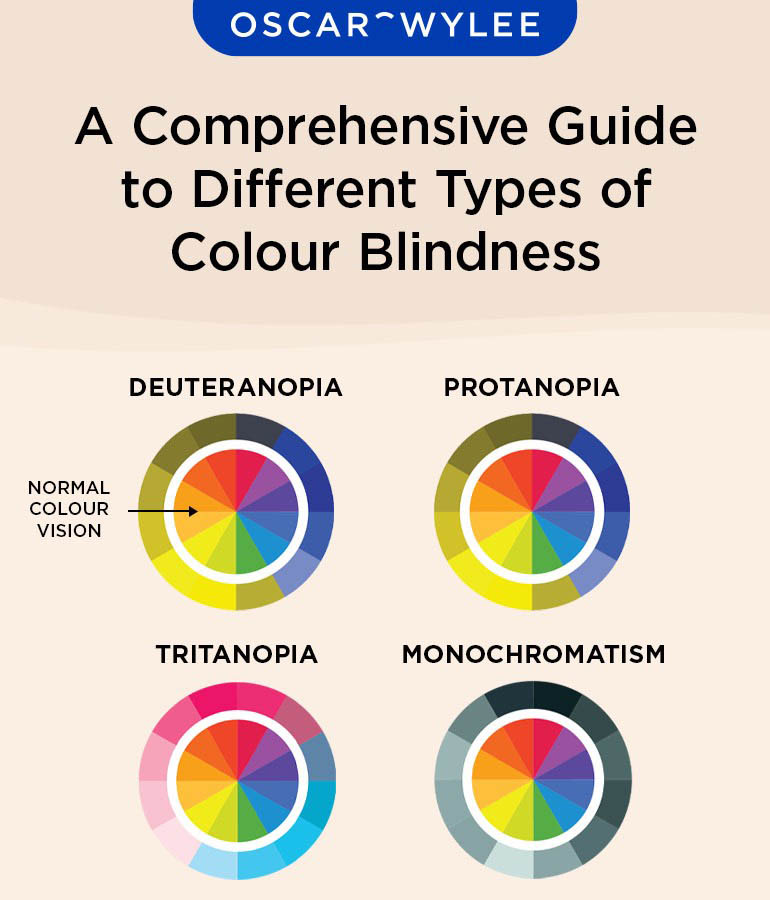
Colour blindness also referred to as colour deficiency, is defined as an eye condition that makes it difficult for the eyes to see colour correctly. Colour blindness may be caused by a function issue with the rods and cones of your eyes and also by inheriting it from your parents. Other causes can include the use of certain medications, medical conditions and head and eye injuries. The three different cones operate as one of the main colour receptors and include red-sensing cones, green-sensing cones and blue-sensing cones. They are also referred to as long-wavelength (L), medium-wavelength (M) and short-wavelength (S) cones. There are different types of colour blindness such as complete colour blindness, blue-yellow colour blindness and red-green colour blindness, which is the most common type of colour deficiency. The four different types of red-green colour blindness are deuteranomaly, protanomaly, protanopia and deuteranopia. Blue-yellow colour deficiency is less common and has two types which include tritanomaly and tritanopia.
The comprehensive guide to different types of colour blindness are monochromatism (complete colour blindness), blue-yellow colour blindness and red-green colour blindness. The list of different types of colour blindness and their definitions are listed below.
- Monochromatism (complete colour blindness): Monochromatism also known as complete colour blindness occurs when you cannot see any colour at all.
- Blue-Yellow Colour Blindness: Blue-yellow colour blindness can include tritanopia; one of the two types that causes difficulty of the eyes to differentiate between blue, green, red, pink, purple and yellow. Tritanomaly, the second type, hinders the eyes from differentiating between blue and green and yellow and red.
- Red-green colour blindness: Red-green colour blindness has four types which include protanomaly, deuteranomaly, protanopia and deuteranopia.
Monochromatism (Complete Colour Blindness)
Monochromatism is known as complete colour blindness and hinders the eyes from perceiving all colours. Due to the lack of working cone photoreceptors, people with this type of colour deficiency may only be capable of seeing grey colours according to the National Library of Medicine. Individuals with monochromatism may also be susceptible to other vision problems such as nystagmus and low visual acuity according to the Nature Journal. Complete colour blindness is considered the most rare and severe type of colour blindness and cannot be treated. It is generally caused by genetic defects and can appear during infancy.
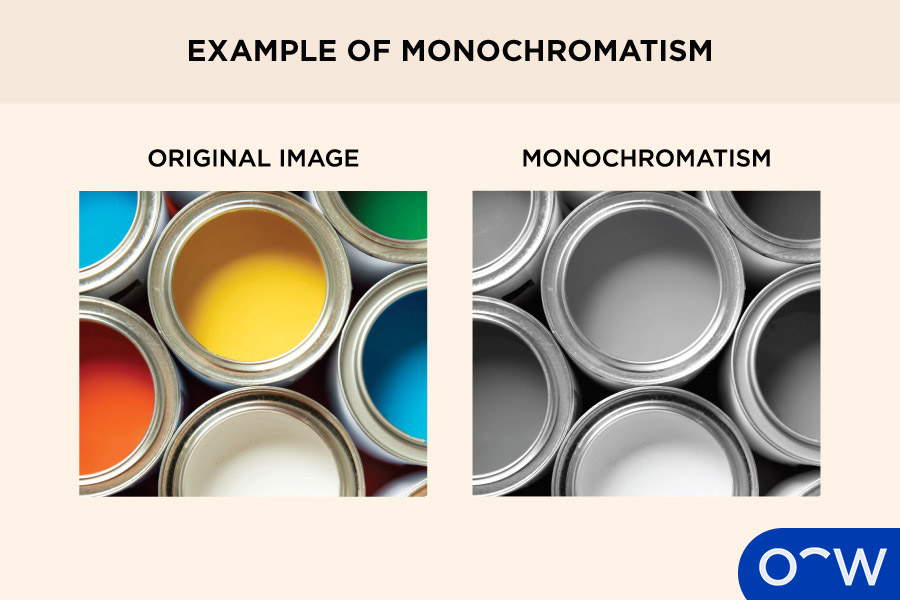
The image shows a comparison between an image of paint cans with colour and what that image may look like with monochromatism.
Blue-Yellow Colour Blindness (Tritanopia, Tritanomaly)
The different types of anomalous trichromacy also known as blue-yellow colour blindness are tritanopia and tritanomaly. The types of anomalous trichromacy and their definitions are listed below.
- Tritanopia: Tritanopia is a type of blue-yellow colour blindness that hinders the eyes from differentiating between blue, green, red, pink, purple and yellow.
- Tritanomaly: Tritanomaly is another type of blue-yellow colour blindness that causes difficulty for the eyes to distinguish between blue and green and yellow and red.
1. Tritanopia
Tritanopia is described as a rare type of blue-yellow colour blindness that makes it difficult to differentiate between blue and green, purple and red, and yellow and pink. Tritanopia can occur as a consequence of absent S cones in the eye according to the Cleveland Clinic. Along with the other cones, S cones are located in the back of the eye and are known as the blue-sensing cones also referred to as short-wavelength cones. Therefore, missing S cones can affect the eye’s ability to distinguish between colours such as green, red, pink, yellow and purple as they have features of either blue or yellow according to Healthline. A person with tritanopia may see red and green colours that appear darkened according to Vision Centre. However, it is important to note that this can differ between individuals. While tritanopia cannot be fixed, there are certain ways to help people cope. This can include labelling pieces of clothing to indicate the colour, and using brighter lighting that closely resembles daylight around your home as colour vision does not function in the dark. Familiarising yourself with the scents of different foods when cooking may also be helpful as you can rely on another sense when carrying out tasks such as cooking. Memorising the colours of items you use daily can also be a helpful way to cope with tritanopia.
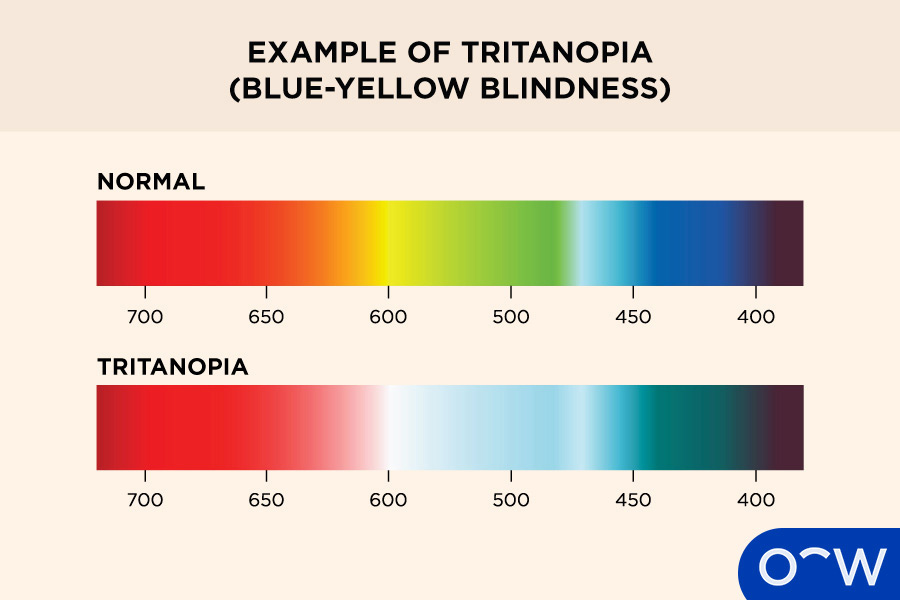
The image shows a range of colours that someone with normal colour vision can see compared to the limited range of colours that someone with tritanopia may see.
2. Tritanomaly
Tritanomaly is another type of blue-yellow colour blindness that occurs when the S cones of the eye are present but are not functioning properly. Tritanomaly may cause the inability to distinguish between red and yellow and between blue and green. Tritanomaly differs from tritanopia as it can make red and yellow look similar and blue and green look similar, whereas tritanopia causes the inability to distinguish between colours that contain attributes of blue or yellow. Like with tritanopia, people with tritanomaly may see red and green colours according to Healthline. Tritanomaly cannot be cured, however, by incorporating practices such as labelling important items and clothing pieces with their colours. Bright lighting around your home and having a list of colours to remember, such as road signs and road markings. It may also be useful to adapt to using your other senses such as smell and touch for tasks such as food shopping or cooking.
Red-Green Colour Blindness (Protanomaly, Deuteranomaly, Protanopia and Deuteranopia)
The different types of deuteranomaly also known as red-green colour blindness are protanomaly, deuteranomaly, protanopia and deuteranopia. The types of deuteranomaly and their definitions are listed below.
- Protanomaly: Protanomaly is a mild form of red-green colour blindness that can make the appearance of red colours look more green and darkened.
- Deuteranomaly: Deuteranomaly is the most common type of red-green colour blindness that results in green colours appearing red.
- Protanopia: Protanopia can occur as a result of absent L cones and can cause the inability of the eyes to see red colours.
- Deuteranopia: Deuteranopia can develop due to missing M cones and can hinder the eyes from seeing green colours.
1. Protanomaly
Protanomaly can be defined as a red-green colour blindness that can alter how the eyes see red colours. Protanomaly can be caused by L cones that are not working properly due to a form of genetic mutation. The defects of a malfunctioning L cone can result in red colours appearing more green than red and darkened or weak and less vibrant. L cones are also referred to as red-sensing cones, which help with detecting red colours. Consequently, people with protanomaly may see blues and greens or may still see red, however, not as strongly. It is important to acknowledge that this may not be the case for all individuals with protanomaly, as this condition and its implications can likely differ depending on the individual. Though protanomaly is not curable, it is considered mild and is not likely to hinder daily activities.
2. Deuteranomaly
Deuteranomaly also known as red colour occurs due to functioning issues in present M cones, which can lead to a defect in how the eyes can see green colours. As a result, deuteranomaly can cause individuals to still see green colours in a less saturated nature according to All About Vision. The other potential implication may be that deuteranomaly may result in seeing green colours appearing more red according to the National Eye Institute. Deuteranomaly is the most common form of colour blindness according to the National Eye Institute, it is categorised as mild and is not curable.
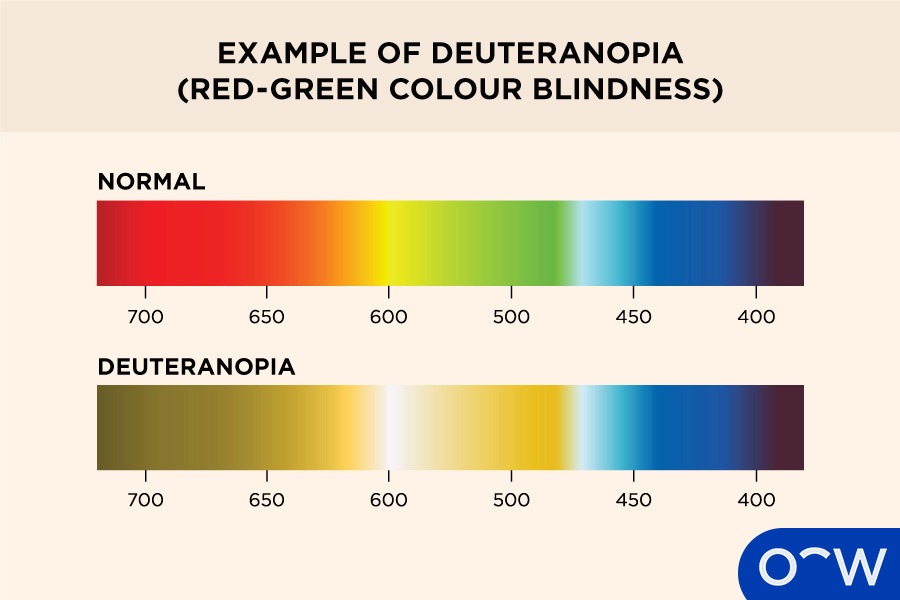
The image shows the range of colours that someone with normal colour vision can see compared to the more limited range of colours someone with deuteranomaly may see.
3. Protanopia
Protanopia is when the eyes are not capable of perceiving red light as a result of missing L cones. Protanopia may be developed from absent L cones as they enable the eyes to see red colours. Therefore, people with this form of colour blindness may only be capable of seeing blues and gold. It may also cause individuals to confuse red colours as black according to the Cleveland Clinic. Protanopia differs from protanomaly as the former causes the inability to see the colour red, while the latter impacts how individuals see the colour red. Protanopia is not curable, therefore, it may be helpful to establish daily living habits accordingly. Labels to indicate colour, ensuring optimal lighting in your home and having a list of the colours of important objects such as road signs and important items that you use daily.
4. Deuteranopia
Deuteranopia impedes the eye’s ability to see shades of green as a consequence of absent M cones. People with deuteranopia may be limited to seeing blue and gold colours only according to the Cleveland Clinic. The M cones allow the eyes to see the colour green, therefore, individuals may confuse red colours with green colours. Another effect may be the confusion of yellow colours with brighter green colours according to the Cleveland Clinic. Like with other forms of colour blindness, deuteranopia colour blindness is not curable.
What is Colour Blindness?
Colour blindness is an eye condition that impedes the eyes from seeing colours properly. There are three different forms of colour blindness which include complete colour blindness (monochromatism), blue-yellow colour blindness and red-green colour blindnessColour blindness may develop as a result of genetics as it can typically occur at birth or due to other causes such as the use of certain medications, medical conditions and head and eye injuries. The two types of photoreceptors that enable colour vision and night vision are known as rods and cones and function by transforming light into signals that are sent to the brain. The cones help with detecting red, green and blue colours and are also known as L cones, M cones and S cones.
How Does Colour Blindness Work?
Colour blindness works when the L cones, M cones and S cones are missing or are not functioning correctly. This can result in the retina’s inability to send visual signals through the optic nerve to reach the brain to help interpret the colours we see. The L cones also known as red-sensing cones recognise long wavelengths, and the M cones also known as green-sensing cones are responsible for sensing medium wavelengths. The S cones also referred to as blue-sensing cones detect short wavelengths.
How Common is Colour Blindness?
Colour blindness can be common, according to the Canadian Association of Optometrists, colour blindness is more prevalent in males than females with it affecting around 1 in 12 males. Red-green colour blindness is the most common form, it mainly affects males and is typically inherited according to Better Health. Colour blindness can occur later in life from conditions such as eye diseases, some medicines, injuries to the brain or eyes, and brain and nervous system diseases according to the National Eye Institute. Colour blindness is a common eye condition that affects 1 in 12 men and 1 in 200 women according to the National Eye Institute.
How Does Colour Blindness Affect a Person's Life?
Colour blindness may affect a person’s daily life as it can alter how everyday tasks are done. Tasks that may be affected can include cooking, driving and clothing-related tasks. When cooking, you may not be capable of knowing if produce has expired or if certain foods are completely cooked. When driving, you may not see the correct colours of road signs and markings or when following traffic lights, ensure you memorise the placement of each light. When shopping, you may not be able to know what colour the items are and identify the colours of your own clothes. People with colour blindness are likely to overcome these small hindrances along with assistance from professionals and family members.
Is Colour Blindness a Disability?
Yes, colour blindness is considered a disability, according to the NCCD, the Nationally Consistent Collection of Data on School Students with Disabilities. Their established definitions include colour-blind individuals or those who use corrective devices as this condition is considered an impairment to the function of the eyes.
Can a Person Be Slightly Colour Blind?
Yes and no, a person is either colour blind or not, however, this condition can vary from mild to moderate and severe between individuals. Therefore, someone with a mild case of red-green colour blindness may still be able to see red colours, however, in a less vibrant and darkened nature.
Can a Colour Blind Person Have Perfect Vision?
Yes, a colour-blind person can have perfect vision, which is a colloquial term for visual acuity, as colour blindness only affects the eyes from perceiving colour and does not prompt impaired vision according to the Vision Eye Institute. Colour blindness occurs as a result of affected or missing cones in the eye and not other vital structures that are responsible for sight.
How to Know What Type of Colour Blindness You Have?
You may know what type of colour blindness you have if you are experiencing difficulty with discerning between reds and greens, seeing green colours appear more red, certain shades of red look more green, are incapable of distinguishing between blues and greens and yellows and reds and have an affected perception of blue colours. This condition is typically present at birth, however, can also occur at any age. The ways to know what type of colour blindness you have and their definitions are listed below.
- Experiencing Difficulty Differentiating Between Reds and Greens: If you’re experiencing trouble differentiating between red colours and green colours completely, this may indicate you have protanopia and deuteranopia (red-green colour blindness).
- Seeing Green Colours Appear More Red: If you are seeing green colours appear more red, this may be a sign you have deuteranomaly (red-green colour blindness).
- Certain Shades of Red Look More Green: If you see green in red colours and in a less bright nature, you may be experiencing protanomaly.
- Incapable of Distinguishing Between Blues and Greens and Yellows and Reds: If you are struggling to discern between blue colours and green colours and between yellow colours and red colours, this could indicate tritanomaly (blue-yellow colour blindness).
- Affected Perception of Blue Colours: If you cannot differentiate between reds, pinks, purples and greens, you may be experiencing tritanopia. This type of blue-yellow colour blindness affects your perception of colours that contain attributes of either blue or yellow.
- Unable to See All Colours: If you are unable to see any colour, you most likely have monochromatism (complete colour blindness).
What Kind of Eye Doctor Diagnoses Colour Blindness?
An optometrist or your local doctor can diagnose colour blindness. According to Health Direct, an optometrist is capable of checking for colour blindness through different colour vision tests. An optometrist is not an >eye doctor >, however, they hold all the necessary qualifications to diagnose a wide range of eye conditions such as this one.
Can You Be Colour Blind Without Knowing?
Yes, you can be colour-blind without knowing as symptoms can often range in severity depending on the individual. According to the National Eye Institute, some people are unaware they have colour blindness as the condition’s implications can be very mild.
Can You Self-Diagnose Colour Blindness?
Yes, you can self-diagnose colour blindness using some online tests that may closely replicate the traditional tests used by optometrists. You may use an Ishihara test which consists of coloured plates with coloured dots and a number usually in a different colour on top. If you are not able to see the numbers, you may likely be colour-blind, which you can consult further with an optometrist to confirm. If you experience any sudden changes to colour vision, seek immediate medical attention or see your optometrist.
What Causes Colour Blindness?
The causes of colour blindness may include genetics as it can be passed down from your parents, the use of certain medications and medical conditions. Other extreme causes may include eye injuries, certain types of brain tumours, retinal detachment and radiation treatments, according to the National Eye Institute.
Can Glaucoma Cause Colour Blindness?
Yes, glaucoma may cause colour blindness in the initial stages. Patients with glaucoma were found to be susceptible to colour blindness due to factors such as increased eye pressure and a damaged optic nerve head or changes to the visual field, according to the National Library of Medicine. However, it is important to note that glaucoma does not inherently lead to colour blindness. Due to the negative effect of the pressure on the optic nerve, colour blindness may develop as the optic nerve carries the visual signals that are sent from the eyes to the brain.
How is Colour Blindness Treated?
Colour blindness cannot be completely treated, however, you can establish certain habits when carrying out certain tasks to help. These can include labels to indicate colours, having a list of important objects and personal items and their colours and using your touch and smell.
Do Colour Blind Glasses Work?
Yes and no, colour-blind glasses may not work for every individual with colour blindness. The effectiveness of colour-blind glasses depends on the severity of their condition and whether it is caused by a defect in their photoreceptors or absent photoreceptors. According to the American Academy of Ophthalmology, colour-blind glasses are created with certain substances to either filter out or take in certain wavelengths of light. For those with colour blindness caused by photoreceptor issues, these glasses may be able to alter what they see when they use them, however, it can be a different case for each individual. Oscar Wylee does not offer colour-blind glasses or any product for colour vision issues.
What is the Difference Between Colour Blindness and Corneal Diseases?
The difference between colour blindness and corneal diseases is how they affect the eye and how they develop. Colour blindness is an eye condition that hinders your ability to see certain colours or distinguish between certain colours and is typically inherited. Corneal diseases refers to a group of eye diseases that affect the cornea and can include eye infections, injuries, inflammation and dry eyes. Corneal diseases can develop as a result of several factors, however, the most common causes may be from viral or bacterial infections.
Read A Comprehensive Guide to Different Types of Colour Blindness in other Oscar Wylee regions and their languages.
Canada