


Checkup Eye Exam: Definition, and What to Expect?
Published on February 7th, 2025
 Canada

An eye check-up is another term for an eye exam or eye exam that is performed by an optometrist to assess a person’s vision and the health of their eyes. A checkup eye exam is defined as a series of procedures and tests relating to the eye and vision. A person can expect a series of eye exams performed to assess if a person requires corrective eyewear such as prescription glasses, or has any existing eye conditions that may need treatment. Some of these tests include a visual acuity test, a visual field test, a slit-lamp exam and a tonometry test. An optometrist may also refer a patient to an ophthalmologist if they detect a condition or issue in a checkup eye exam that requires more advanced treatment from an eye doctor.
An eye doctor is a colloquial term often used globally to refer to an optometrist. While optometrists are qualified to diagnose eye conditions and prescribe certain treatment methods, they are not considered doctors. On the other hand, an ophthalmologist is a qualified eye doctor who performs surgeries and often deals with more advanced and complicated eye conditions.
What is an Eye Exam?
An eye exam or exam is a procedure performed by an optometrist to assess a person’s vision and the health of their eye. An eye exam is typically performed by an optometrist and is crucial in maintaining eye health as it can detect a large variety of eye diseases and vision issues. Some of the vision issues and eye diseases that can be diagnosed and detected in an eye exam include refractive errors, such as myopia (nearsightedness) and hyperopia (farsightedness), glaucoma, cataracts and macular degeneration.
A person should book a regular eye exam every 1-2 years to ensure they are taking care of their eye health. An eye exam is important as an optometrist can diagnose and treat certain eye conditions early on, so they do not develop into a bigger problem later on. Even if you feel your vision is clear or you are not noticing any issues, it is still important to get your eyes tested regularly.
How Does a Checkup Eye Exam Work?
A checkup eye exam works by assessing a patient's vision and eye health, performed by an optometrist, in order for them to provide the proper treatment whether that is prescribing prescription glasses, treating certain eye conditions, or referring the patient to an ophthalmologist for further or more advanced treatment. In an eye exam, a patient will go through pre-testing with an optical assistant which will assess eye pressure. Next, the optometrist will perform further tests, often a visual acuity test, a refraction test and a slit-lamp test. If the patient requires corrective eyewear, the optometrist will provide a prescription which is handed over to an optician who can help the patient find the frames and lenses to suit their visual and lifestyle needs.
What to Expect During a Checkup Eye Exam?
Some of the tests to expect during a checkup eye exam include a retinal exam, colour vision test, visual field test, tonometry test, eye muscle test, refraction test, dilated pupil exam, slit-lamp exam and OCT (optical coherence tomography) and fundus photography test. The tests you can expect during a checkup eye exam are listed below.
- Retinal exam: A retinal exam, also known as a fundoscopy, is performed by an eye care professional to evaluate the back of a person’s eye. This exam often requires the patient’s eyes to be dilated for better visualisation.
- Colour vision test: A colour vision test is commonly done on children and upon indication such as occupational testing. This test is used to detect what colours a person can see and is typically performed using a colour plate.
- Visual field test: A visual field test is performed on indication only and is used to assess a person’s visual scope and peripheral vision. It is conducted to quantify how well a patient sees through each eye, both individually and binocularly.
- Visual acuity test: A visual acuity test is performed by an optometrist to determine the clarity and sharpness of a person’s vision. It is typically conducted using a Snellen eye examing chart or a LogMAR chart.
- Tonometry test: A tonometry test is performed during pre-testing and is used to measure a patient’s intraocular eye pressure. A tonometry test is often used to assess for glaucoma as this eye condition can be associated with high eye pressure.
- Eye muscle test: An eye muscle test, also known as an extraocular muscle function test, checks to ensure the muscles around the eye are working together correctly.
- Refraction test: A refraction test is used to detect refractive errors such as nearsightedness, farsightedness and astigmatism. The types of refraction tests include a phoropter refraction test, retinoscopy and an autorefractor test.
- Dilated pupil exam: A dilated pupil exam is performed on indication and refers to a procedure that requires an optometrist to dilate a person’s eyes in order to have a better view of the eye’s inner structures
-
Slit-lamp exam:
A slit-lamp exam is a test that examines the different structures of
the eye including the lens, cornea, optic nerve and retina.
- OCT (optical coherence tomography) and fundus photography test: OCT and Fundus Photography are imaging tests that allow eye care professionals to obtain detailed images of the structures of the eye.
1. Retinal Exam
A retinal exam, also known as a fundoscopy and ophthalmoscopy, is a diagnostic test that enables the optometrist to inspect the retina and optic nerve located at the back of the eye. The procedure typically involves using specialised tools like an ophthalmoscope or a slit-lamp biomicroscope to detect any indications of eye diseases or irregularities. Eye drops may be administered to dilate the pupils, which permits a more thorough examination of the retina. According to the National Cancer Institute, a retinal exam, or fundoscopy, is used to check for macular degeneration, glaucoma, eye injuries and eye cancer. According to Standford University, a retinal exam is very beneficial as it can provide important information about a medical diagnosis such as high blood pressure and diabetes.
2. Colour Vision Test
A colour vision test is used to detect what colours a person can see. Colour blindness, more accurately known as colour vision deficiency, is an eye condition that causes a person to have trouble seeing specific colours, or, it may mean a person sees colours in a different way to other people. Colour vision deficiency is the more accurate term for colour blindness, which is used more colloquially, as people who have this condition, may not be completely blind to colour, rather they only see certain colours.
According to the National Eye Institute, to test for colour blindness, an optometrist typically uses a colour plate test. This test uses images made up of different coloured dots with a number in the middle that a patient is asked to identify. There are different colour plates made up of certain colours to identify different types of colour vision deficiency.
3. Visual Field Test
A visual field test (VFT)is a procedure performed by an eye care professional to quantify how well a patient sees through each eye, both individually and binocularly. A visual field test aids an optometrist in establishing a baseline for a person’s vision to diagnose eye diseases or injuries. This test works by mapping the person’s visual scope as well as their peripheral vision to identify if there is any vision loss.
A visual field test is typically performed using a machine such as a static automated perimetry test or frequency doubling perimetry. The time frame for a visual field test varies depending on the test that is being performed and the model of the machine, varying from 10-40 minutes. The test typically involves the patient identifying objects or light that appears in their periphery (the sides of their vision) and they are tasked with pressing a response button when they see a light pop up. The results of a visual field test will typically be printed as a map and interpreted by the optometrist.
4. Visual Acuity Test
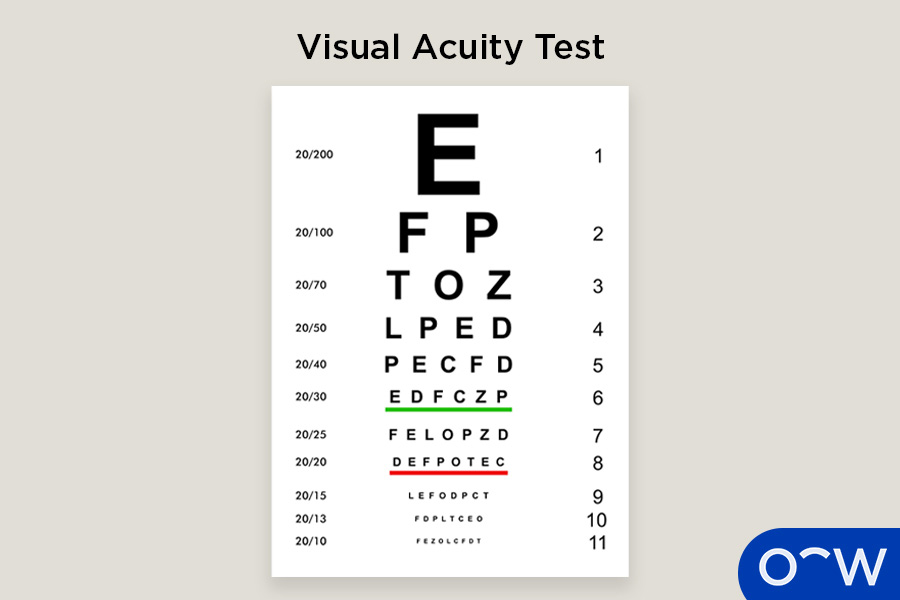
A visual acuity test is a standard component of an eye exam that evaluates a person's ability to see distant objects. The visual acuity examination involves reading letters or symbols displayed on an eye chart, which is usually positioned 20 feet away from the person, or 6 metres in the metric system. The eye chart is typically a Snellen eye examing chart or a LogMAR chart which tests the clarity and sharpness of a person’s eyesight. In case the smallest letters on the chart are not legible, the individual may be asked to move closer to the chart until they are able to read them. Alternatively, the test can be conducted with a handheld or computerised chart.
The optometrist will instruct the patient to cover one eye and read letters off the eye chart that get progressively smaller until they are unable to read the letters clearly. This process is then repeated with the other eye covered. The further down the chart a patient sees, the better the visual acuity is. The outcome of the visual acuity test is expressed as a fraction, and it helps detect refractive errors such as nearsightedness, farsightedness, and astigmatism. If a person is diagnosed with a refractive error, the optometrist may recommend corrective measures like glasses to improve vision.
5. Tonometry Test
A tonometry test is commonly performed during pre-testing and is used to measure a patient’s intraocular eye pressure. Tonometry is a diagnostic test often used to diagnose glaucoma as people with this codition typically have a high intraocular pressure due to slowly draining fluid in the eye. There are multiple types of tonometry tests used to test intraocular pressure. Non-contact tonometry is a type of tonometry test also known as air puff tonometry. This test uses a rapid air pulse that flattens the cornea which is how it measures intraocular pressure. Another type is Applanation tonometry which requires the patient's eyes to be numb and the pressure is measured with a diagnostic tool while their head is positioned in a slit-lamp.
6. Eye Muscle Test
An eye muscle test checks to ensure the muscles around the eye are working together correctly. An eye muscle test is also known as an extraocular muscle function test and is performed by an optometrist to observe if there are any weaknesses in the muscles of the eye. According to the National Library of Medicine, an eye muscle test involves the patient moving the eyes in eight different directions without moving their head. If a person has issues with eye muscles, it may result in uncontrolled eye movements or double vision.
7. Refraction Test
A refraction test is performed by an eye care professional to determine the necessary correction for a refractive error, according to the Visionary Eye Centre. A refractive error is a type of vision issue that affects a person’s ability to see clearly. Refractive errors include myopia, hyperopia and astigmatism. There are three main types of refraction tests performed by eye care professionals. A phoropter refraction test uses a phoropter to determine the best glasses or contact lens prescription for an individual. The person views various lenses, and the optometrist selects the most appropriate combination of lenses. By interpreting the results, the optometrist can prescribe the appropriate corrective lenses to enhance vision and correct refractive errors. Another type of refraction test is a retinoscopy which uses a retinoscope, a handheld tool that shines a light into a person’s eye. The optometrist will move the light across both eyes to determine how the light reflects off the retina. The final type of refraction test is performed using an autorefractor, which is a computer-controlled machine that measures refraction.
8. Dilated Pupil Exam
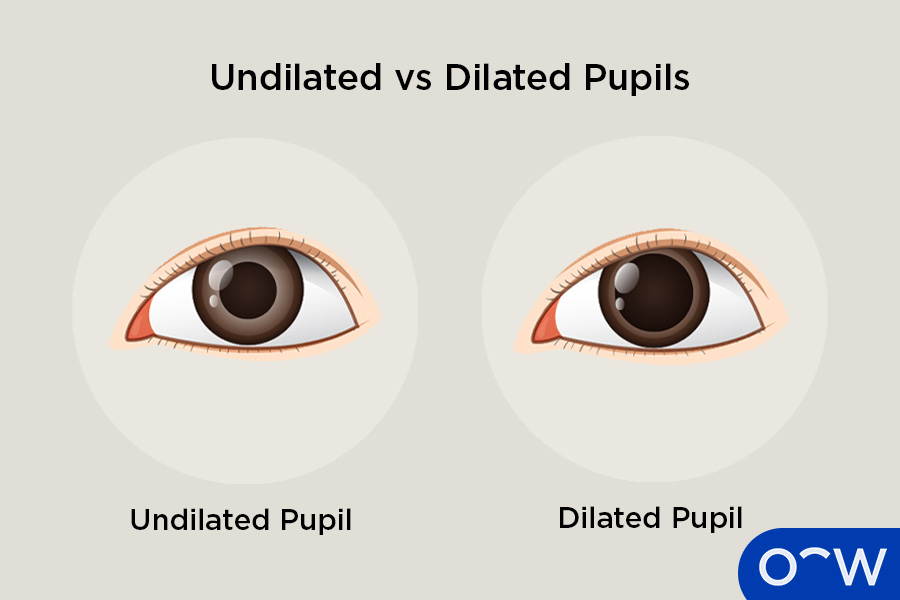
A dilated pupil exam refers to a procedure that requires an optometrist to dilate a person’s eyes in order to have a better view of the eye’s inner structures. A dilated pupil exam is performed by an optometrist to help them get an in-depth picture of their patient's eye health that goes beyond a standard eye exam. This eye exam is used to detect eye conditions including macular degeneration, diabetic retinopathy and glaucoma.
To perform this eye exam, an optometrist will administer eye drops in order to dilate the pupils which will widen the pupil to give the optometrist a better look at the inner structures of the eyes. According to the National Eye Institute, a dilated pupil exam may include a visual field test, a visual acuity test, an eye muscle test, a tonometry test and a pupil response test.
9. Slit-Lamp Exam
A slit-lamp exam is a test that examines the different structures of the eye including the lens, cornea, optic nerve and retina. A slit-lamp exam is performed using a microscope with a bright light and, according to the American Academy of Ophthalmology, is used to produce three-dimensional measurements and visualisation of the eye. This test may require a patient’s eyes to be dilated to allow the eye care professional to have a better visualisation of the eye. A slit-lamp examination is used to observe the eyes for eye diseases and abnormalities such as cataracts, glaucoma and macular degeneration.
To perform a slit lamp exam, an eye care professional, typically an optometrist, will position a patient’s chin on a chin rest connected to the microscope. Their forehead will rest on a band, also connected to the microscope, and the beam of light from the microscope will be used to inspect the eye.
10. OCT (Optical Coherence Tomography) and Fundus Photography Test
OCT (Optical Coherence Tomography) and Fundus Photography are imaging tests that allow eye care professionals to obtain detailed images of the retina and optic nerve, which can help detect and monitor eye diseases and other abnormalities. According to the American Academy of Ophthalmology, an OCT is typically performed by an ophthalmologist and is used to view the distinct layers of the retina. An OCT is used to guide the treatment of certain eye conditions such as age-related macular degeneration, diabetic eye disease and glaucoma.
A fundus photography test is a non-invasive test allowing eye care professionals to view the back of the eye which helps them to provide accurate diagnosis for eye conditions. According to ScienceDirect, the process of fundus imaging involves obtaining two-dimensional images of the retina. Comparing these two imaging techniques, an OCT produces higher-resolution images and is a more modern technique.
What is the Importance of a Checkup Eye Exam?
The answer to why is a checkup eye exam important is simple. A checkup eye exam is an essential tool for maintaining good eye health and detecting any issues related to the eyes early on. Eye exams can help identify vision problems, eye diseases, and other abnormalities that may not have noticeable symptoms in their early stages. Detecting and diagnosing these issues early can lead to more effective treatment and management, helping to prevent vision loss and other complications. It is important to book regular eye exams to maintain the health of your eyes and allow your optometrists to monitor any changes in your vision or eye health.
How Often Should You Have a Checkup Eye Exam?
At Oscar Wylee, we recommend that you have an eye exam every 1-2 years. If you are over 65 years of age, then a yearly eye exam is ideal. Other factors that may determine how often you should have an eye exam include if you have certain medical conditions such as diabetes and high blood pressure which means you will likely need frequent eye exams as these conditions can affect your vision. If you have existing, diagnosed eye conditions such as retinal detachment or glaucoma, your optometrist or ophthalmologist may recommend you book frequent eye exams. It is recommended to get into an eye exam routine, meaning you are booking regular eye exams at least once every two years.
The answer to how long does an eye appointment take can vary depending on the person. An eye appointment will typically only take between 20-30 minutes, therefore, you should make time for an eye exam in your everyday life to ensure the health of your eyes and vision.
How to Find an Optometrist?
You can find an optometrist in Canada by taking a few essential steps that make the process simple and easy. The steps on how to find an optometrist in Canada include searching online to find optometrists near you, choosing the location that is most convenient for your location and finally selecting the date and time for your appointment.
What to Prepare for A Checkup Eye Exam?
Some ways to prepare for getting an eye exam include bringing your glasses to the appointment if you use them. Your current pair of corrective lenses may help the optometrist get a well-rounded and accurate picture of your vision and eye health. Another way to prepare is to be ready to tell the optometrist if you’ve experienced any changes in your vision. It is important to tell them the exact changes you have experienced, if any, when they occurred and how often. This can help the optometrist in assessing the health of your eyes and may also assist in the diagnosis of certain eye conditions. Finally, try to relax before your eye exam. While people may get nervous before an eye exam, it is best to put it out of your mind and also let the eye care professionals know if you are feeling anxious or uncomfortable and they will aim to make your experience as comfortable as possible.

How Much Does a Checkup Eye Exam Cost?
The cost of a checkup eye exam can typically be covered by most private health insurance providers depending on your plan. If your health insurance includes eye exams, we can directly bill them on your behalf. Read more about health insurance providers on our direct billing page. You can contact your private insurance provider directly to determine how much coverage you have for eye exams and for glasses.
Does insurance cover it?
There are many private health insurance providers who do include eye exams in their coverage plans. You can confirm with your provider before booking your eye exam or our team will happily assist you with checking what health benefits you have access to.
What to Do if You Experience Discomfort or Anxiety During a Checkup Eye Exam?
It is important to let your optometrist know if you experience any discomfort or anxiety during a checkup eye exam. If they are informed of how you are feeling, they can help ease your anxieties by talking you through the eye exam and reducing discomfort where possible. Another way to help ease eye exam anxiety is to book the test. Sometimes the hardest part is scheduling the exam, but once it’s done, you can prepare yourself for the appointment and reward yourself for setting it up instead of putting it off for weeks or months. Booking regular eye exams can also help if you experience discomfort or anxiety during an eye checkup as it can help you get used to the process and be aware of the different tests and procedures the optometrist will perform.
What Not to Do Before an Eye Exam?
Generally, there is not much a person needs to do to prepare for an eye exam. The optometrist and staff are equipped to provide high-quality eye exams and will instruct their patients on everything that will need to be done.
Having said that, it is advised that you do not overexert your eyes before the eye exam so that they are not fatigued. This can mean making sure you have adequate rest the day before to ensure you are comfortable. You should also try to avoid drinking an excessive amount of caffeine as it may affect your blood pressure which may be necessary to assess during the eye exam.
How Long Does a Checkup Eye Exam Typically Take?
How long a checkup eye exam typically takes can vary as it depends on the type of tests performed. At Oscar Wylee, we allocate approximately 20 minutes for each eye exam. However, this time frame can vary, especially for those who have more complex eye diseases that require more extensive testing.
Can you Fail an Eye Exam?
No, you cannot fail an eye exam. An eye exam is an assessment of your vision and eye health and the tests performed are used to determine if you need corrective devices and detect any eye diseases or issues. Therefore, you cannot fail an eye exam as everyone’s eyes are unique and will require different treatments.
People may be confusing a regular eye exam performed by an optometrist with the vision test for driver and rider licensing. According to the Drive Test Ontario, the vision test involves looking into the screen reader vision testing equipment, and reading the series of numbers or letters aloud as they get visually smaller in size.
Can a Checkup Eye Exam Detect Eye Diseases?
Yes, a checkup eye exam can detect eye diseases, in fact, an eye exam is the primary way eye conditions or diseases are diagnosed. Not only are eye exams important in detecting and diagnosing eye diseases, they are also used to monitor their progression. Some of the main ways to diagnose and detect eye diseases include a slit-lamp examination. Another test includes optical coherence tomography (OCT) which is used to view eye diseases such as glaucoma and macular degeneration. According to the American Academy of Ophthalmology, OCT is a non-invasive imaging test that is used to take pictures of the retina.
Can an Eye Exam Detect Optic Neuritis?
Yes, an eye exam can be used to detect and diagnose optic neuritis. Optic neuritis is an eye condition that develops when the optic nerve is inflamed and swollen causing pain in the eye and in some cases vision loss or impaired vision. An ophthalmologist and optometrist can check your optic nerve for inflammation by shining a light into your eyes with a slit lamp.
Is a Checkup Eye Exam Necessary for Maintaining Good Eye Health?
Yes, a checkup eye exam is necessary for maintaining good eye health as it ensures your eye health is being monitored so that if anything changes or you develop an eye condition, an optometrist will be able to diagnose and provide the proper treatment. Undetected eye conditions can be a major issue as for some conditions like glaucoma and diabetic retinopathy, early detection can prevent partial or complete vision loss.
A checkup eye exam is also necessary as you may have uncorrected vision issues that an optometrist can help with by providing a prescription for corrective lenses. Many people assume that their eyesight is perfect, but the only way to know what your vision is like is to have it assessed by an optometrist.
Read Checkup Eye Exam: Definition, and What to Expect? in other Oscar Wylee regions and their languages.
Canada